

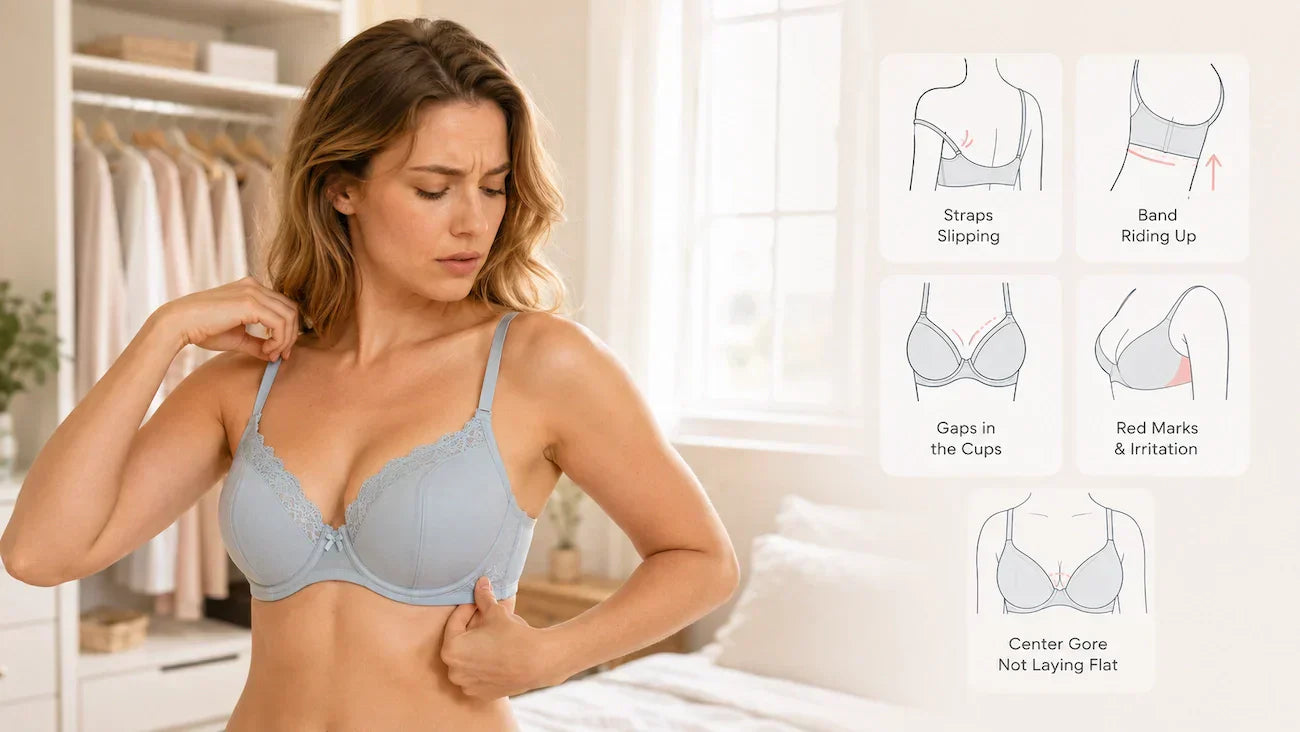
If your bra is uncomfortable more often than not, you're probably not alone — and it's probably not your body that's the problem.
Why Your Bra Never Feels Quite Right
Most women figure out their bra size once — maybe in a fitting room years ago, maybe from a quick online calculator — and stick with it. But bra sizing is not a fixed number. Bodies change with weight shifts, hormones, pregnancy, and age. And even within the same size, different brands, different bra styles, and different constructions can all fit completely differently.
The truth is, the majority of fit issues come down to one of three things: the wrong size, the wrong style for your body shape, or a bra that's simply worn out. A bra that fit perfectly six months ago may not fit the same way today. And a bra that looks fine in the mirror might still be causing discomfort in ways you've learned to ignore — strap marks, shifting throughout the day, a band that creeps up by noon.
None of that is normal. A well-fitting bra should be something you barely notice you're wearing.
The Most Common Bra Fit Problems & How to Fix Them
Bra Fit issues tend to show up in the same places: the band, the straps, the cups, the underwire. Once you know what to look for — and why it's happening — most of these issues are genuinely fixable, either with adjustments or by finding a better-suited style.
The Band Keeps Riding Up

The back of your bra creeps upward throughout the day while the front stays put. This almost always means the band is too loose. The band is responsible for around 80% of a bra's support — when it can't anchor itself to your ribcage, it has nothing to hold it down in the back.
How to fix it: Try going down one band size. To keep the same cup volume, go up one cup letter at the same time — a 36C becomes a 34D, for example. On your current bra, make sure you're starting on the loosest hook; as the elastic stretches over time, you can tighten it gradually.
Your Straps Are Digging In (or Falling Off)

Straps that dig in are usually overcompensating for a band that isn't doing its job — the straps get tightened to make up for lost support, which puts all the pressure on your shoulders. Straps that fall off often point to narrow or sloped shoulders, or again, a band that's too loose and pulling everything out of position.
How to fix it: If straps dig in, loosen them slightly and check your band fit first. You should be able to slide two fingers under your band comfortably. If straps fall off, try a racerback converter or look for styles with center-pull straps. Wider straps also distribute weight more evenly if digging is a recurring issue.
Cups That Gap, Wrinkle, or Spill Over

Gaping or wrinkling at the top of the cup usually means the cup is too large, or the cup shape doesn't suit your breast shape — shallow breasts tend to gap in projected cups. Spillage over the top or sides means the cup is too small, and your breast tissue has nowhere to go.
How to fix it: For spillage, size up in the cup. For gaping, try a smaller cup or a different style — demi and balconette cuts often work better for less projected shapes. Keep in mind that cup shape matters just as much as cup size; switching styles in the same size can sometimes resolve both issues without changing your number at all.
The Underwire Pokes, Digs, or Sits Wrong

Underwire should sit flush against your ribcage, encircling your breast tissue completely without sitting on top of it. If it pokes into your sides or digs under your arms, the wire is likely too narrow for your breast root width. If it digs into your sternum, the cup may be too small.
How to fix it: Go up a cup size and check that the wire follows the natural crease where your breast meets your chest wall. If underwire consistently causes problems regardless of fit, it may be worth trying wireless styles — modern wireless construction has improved significantly and can offer comparable support for many body types.
The Center Gore Won't Lie Flat

The gore — the small panel between the two cups — is supposed to sit flat against your sternum. When it floats away from your body, it almost always means the cups are too small. Your breast tissue is pushing the whole structure forward.
How to fix it: Go up one cup size. If you have very close-set breasts with little natural gap, even a well-fitted bra may lift slightly at the center — in that case, a plunge style with a low, narrow gore is designed specifically for that anatomy.
Red Marks After Taking It Off

Some light impressions from a bra band are normal at the end of a long day. Deep red marks that linger, or marks from the underwire digging into skin, are not. This typically points to a band that's too tight, an underwire sitting in the wrong position, or fabric that's rough against the skin.
How to fix it: Check your band size first — if you can barely get two fingers underneath it, size up. For underwire marks on the skin rather than around the breast, the wire width is likely wrong. Soft, flexible fabrics and wire-free styles can also make a meaningful difference if skin sensitivity is part of the issue.
The Whole Bra Just Shifts Around All Day

If you're constantly adjusting — pulling the band down, repositioning cups, nudging straps back up — the bra isn't stable on your body. This usually comes back to a band that's too large, but it can also mean the bra style isn't suited to your breast shape or activity level.
How to fix it: Start with the band. A properly fitted band should feel snug but not tight, and it should not move when you raise your arms. If the band fits but shifting persists, consider whether the cup style is appropriate — some cuts simply work better for certain shapes, and finding the right one can make an immediate difference.
Still Uncomfortable? It Might Be Time for a New Bra
If you've tried adjusting and resizing but nothing quite works, the bra itself might be the issue — either it's reached the end of its life, or it was never the right construction for your body to begin with.
One style that's been gaining real attention for fit-related reasons is the wireless, seamless jelly bra. Unlike traditional underwired bras, jelly bras are built around a soft, flexible gel-based material — often referred to as Jelly Gel® Technology — that adapts to your body's shape rather than imposing a fixed structure onto it. The result is a bra that moves with you, without the common pressure points that come from rigid underwire or stiff foam cups.
For anyone who struggles with underwire digging in, bands that feel too restrictive, or marks at the end of the day, the construction difference is noticeable. The gel material distributes support more evenly across the breast, which also helps with shifting and stability. And because the fit is more forgiving by design, it tends to work across a wider range of body shapes and sizes — including fuller figures that often find standard bra constructions fall short.
It's not a one-size-fixes-all answer, but if traditional bras have consistently let you down, it's a genuinely different approach worth trying. Sometimes the fix isn't a better size — it's a better bra.
Share:
What Is the Smallest Bra Size? Facts & Answers